Grateful to be featured in The Times of India- By Dr Anil Patil| Orthopaedic Surgeon | Arthroscopy & Sports Medicine | Joint Replacement
Vijayanagar, Bengaluru
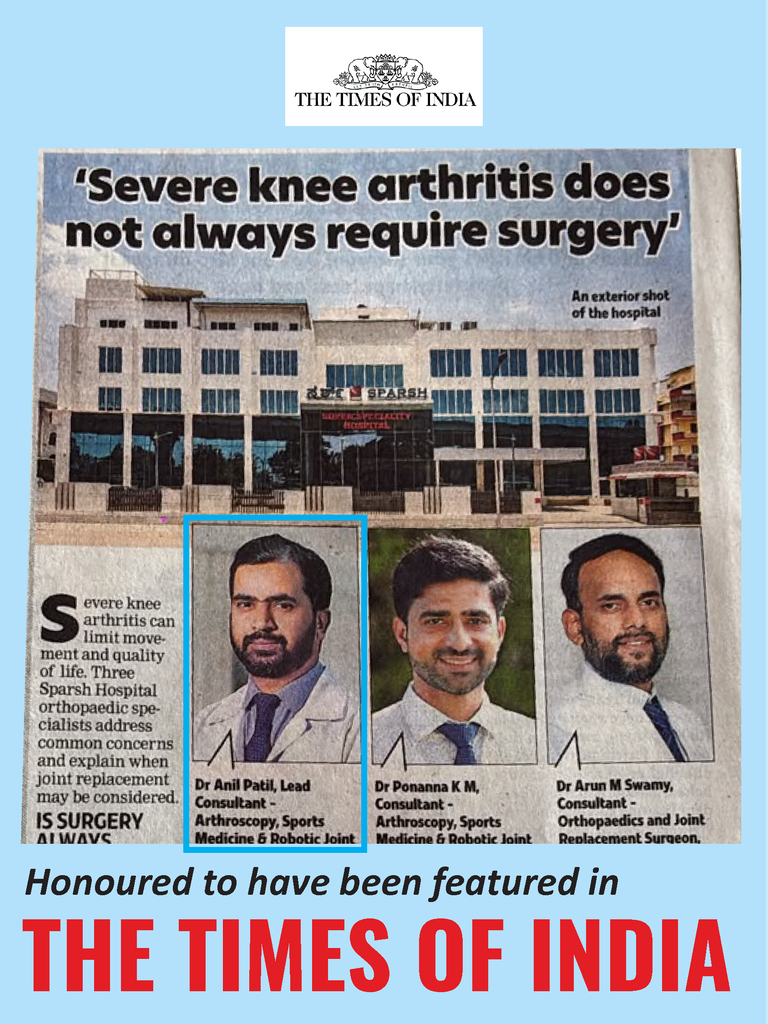
Being featured in The Times of India on 26 September 2026 was a genuinely meaningful moment for me.
As a doctor, there are many ways to measure a professional journey. There are surgeries performed, patients who return to their routines, athletes who get back on the field, families who finally see a loved one walk without constant pain, and countless consultations that may never make it into a newspaper.
So when I saw myself featured in The Times of India alongside fellow orthopaedic specialists in a discussion around severe knee arthritis, knee replacement, when patients should seek medical advice and how modern technology is changing orthopaedic care, I felt both grateful and reflective.
For me, the feature was not simply about being in a newspaper.
It was about an opportunity to talk about something I encounter regularly in my practice — how people make decisions when knee pain starts affecting their lives.
And perhaps more importantly, why knee replacement surgery should not automatically be the first answer to every painful knee.
Knee Pain Is Common. Ignoring It Shouldn’t Be.
I have spent much of my professional life dealing with problems involving the knee and shoulder, including sports injuries, ligament injuries, arthritis, arthroscopic conditions and joint replacement.
My training and experience in arthroscopy, sports medicine and joint replacement have allowed me to see knee problems across a wide spectrum.
But one thing remains consistent:
No two patients experience knee pain in exactly the same way.
For one person, knee pain might appear after a long walk.
For another, it may make climbing stairs difficult.
Someone else may struggle to get up from a chair, sleep comfortably or perform simple household activities.
And for an active individual, knee pain could mean being unable to run, play badminton, cycle or participate in the activities they enjoy.
This is why I believe that treating the person is just as important as treating the X-ray.
An X-ray may show arthritis. An MRI may show a ligament injury. A clinical examination may identify instability or restricted movement.
But the final treatment decision has to consider the complete picture.
Does Every Patient With Knee Arthritis Need Knee Replacement?
No. And that is what I said in The Times of India.
This is one of the most important points I would like patients to understand.
Severe knee arthritis can significantly affect mobility and quality of life, and in appropriately selected patients, knee replacement can be an important treatment option.
But knee replacement is not automatically the first treatment for everyone with knee pain or arthritis.
When I evaluate a patient, I look at several factors, including symptoms, severity of arthritis, mobility, overall health, functional limitations and how the condition is affecting everyday life.
Depending on the individual situation, treatment may involve lifestyle modification, medication, physiotherapy, exercise-based rehabilitation, injections or other non-surgical approaches before major surgery is considered.
The objective isn’t simply to perform a procedure.
The objective is to determine what treatment is appropriate for that particular patient at that particular stage of their condition.
That distinction matters.
When Should You See an Orthopaedic Doctor for Knee Pain?
One of the questions I hear frequently is:
“How do I know when my knee pain has become serious enough to see a specialist?”
There isn’t one universal threshold, but certain symptoms should not simply be brushed aside as “age-related pain.”
Persistent knee pain that interferes with sleep or everyday activities deserves evaluation.
Difficulty climbing stairs, progressive stiffness, swelling, reduced mobility, difficulty getting up from a chair or increasing difficulty walking are also reasons to seek medical advice.
Progressive deformity or persistent symptoms despite rest and basic measures are additional reasons to have the knee assessed.
The important point is not to wait until your knee becomes completely disabling before seeking help.
Early assessment does not necessarily mean surgery.
In fact, an early orthopaedic consultation may help determine whether surgery can be avoided, postponed or whether another treatment pathway is more appropriate.
My Work in Vijayanagar, Bengaluru
My practice in Vijayanagar, Bengaluru, is particularly close to my professional journey.
At The Orthopaedic and Sports Med Clinic, I see patients with a wide range of orthopaedic concerns, from everyday joint pain to sports-related injuries and more complex conditions involving the knee, shoulder and other joints.
Vijayanagar and the surrounding areas have a diverse patient population, and one of the things I value most about practising here is the opportunity to work with people from different walks of life.
A knee isn’t just a joint on an X-ray.
It is what allows you to walk to work.
Climb the stairs.
Play with your children.
Exercise.
Travel.
Play a sport.
Stand for long periods.
And sometimes simply get out of bed without thinking about pain.
That is why restoring function and quality of life is such an important part of orthopaedic care.
From Sports Injuries to Arthritis: The Knee Has a Long Story to Tell
My work also includes arthroscopy and sports medicine, including the management of conditions involving the knee and shoulder, ligament injuries and sports-related problems.
At first glance, sports injuries and knee arthritis may appear to be completely different problems.
In reality, both require the same fundamental approach:
Understand the problem before deciding how to treat it.
A young athlete with a ligament injury may want to return to competitive sport.
An older patient with advanced arthritis may want to walk comfortably to the market.
Their goals are different.
Their diagnosis may be different.
Their treatment may be different.
But the principle remains the same — the treatment plan should be built around the patient’s condition and goals.
Where Does Robotic Knee Replacement Fit In?
Technology has changed significantly in orthopaedics.
Today, robotic-assisted systems can support surgeons during knee replacement procedures by providing detailed planning and helping with aspects of surgical execution.
However, I always believe that technology should remain a tool in the hands of the surgeon, rather than becoming the focus of the treatment itself.
A robotic system does not replace clinical judgement.
The surgeon still has to evaluate the patient, understand the anatomy, determine whether knee replacement is appropriate and select the right surgical strategy.
For patients who are appropriate candidates for robotic-assisted knee replacement, technology can form part of a carefully planned surgical pathway.
But the most important question should always remain:
Does this patient actually need a knee replacement?
Not:
Can we perform a technologically advanced procedure?
That difference is important.
My Approach to Knee Replacement
When knee replacement becomes appropriate, my role extends beyond the operating room.
A successful orthopaedic journey involves assessment, planning, surgery where indicated, rehabilitation and follow-up.
The patient’s understanding of the procedure is also extremely important.
I encourage patients to ask questions.
What exactly is causing the pain?
How severe is the arthritis?
What are the alternatives?
Can physiotherapy help?
Would lifestyle changes make a difference?
Is an injection appropriate?
What happens if surgery is postponed?
If surgery is recommended, what type of replacement is being considered?
What does rehabilitation look like?
These are not unnecessary questions.
They are part of informed healthcare.
Why Patient Education Matters to Me
One of the reasons I appreciated being part of the Times of India feature is that medical conversations should not remain limited to hospitals and consultation rooms.
Patients increasingly search online before visiting a doctor.
They search for terms such as:
“best orthopaedic doctor in Bangalore”
“knee pain treatment in Bangalore”
“knee arthritis treatment”
“knee replacement surgery”
“robotic knee replacement”
“ACL injury treatment”
“sports injury specialist”
and “orthopaedic surgeon in Vijayanagar.”
That makes accurate medical information more important than ever.
Search engines can provide thousands of answers.
Social media can provide hundreds of opinions.
But healthcare decisions require something more than an algorithm.
They require proper clinical evaluation.
A Newspaper Feature Is an Honour — But It Is Also a Responsibility
Being featured in The Times of India is something I am genuinely grateful for.
But I don’t see it simply as recognition.
I see it as another opportunity to communicate with patients.
Orthopaedics has evolved considerably, and patients today have access to treatments, technology and information that were not available in the same way decades ago.
At the same time, more information does not always mean better information.
My responsibility as an orthopaedic surgeon is to help patients understand their condition, discuss appropriate options and make treatment decisions based on their individual circumstances.
Sometimes that may mean surgery.
Sometimes it may mean physiotherapy.
Sometimes it may mean changing an activity.
And sometimes it may simply mean monitoring the condition and returning for review when necessary.
To Everyone Who Has Trusted Me (including you, Times of India)
Every feature, every professional milestone and every photograph in a newspaper represents something much bigger behind the scenes — patients who trusted me with their health.
To the patients who have walked into my clinic in Vijayanagar with knee pain, shoulder injuries, sports injuries, arthritis or uncertainty about what to do next, thank you.
To the families who placed their confidence in me during difficult treatment decisions, thank you.
To the patients who committed themselves to rehabilitation after surgery, thank you.
And to everyone who has recommended my practice to another patient, I am deeply grateful.
A doctor may perform the procedure, but recovery is always a journey shared with the patient.
Looking Ahead
My journey in orthopaedics continues to evolve.
From sports medicine and arthroscopy to knee and shoulder care and joint replacement, my focus remains on combining clinical experience with evidence-based treatment and an understanding of what each patient actually needs.
The Times of India feature on 26 September 2026 gave me an opportunity to speak about knee arthritis and joint replacement.
But my larger message remains simple:
Knee pain should not automatically be accepted as an inevitable part of ageing.
At the same time, surgery should not automatically be considered the answer to every knee problem.
The right place to begin is with an accurate diagnosis, a proper clinical assessment and an honest conversation about treatment options.
For patients in Vijayanagar, West Bengaluru and surrounding areas, my team and I continue to work towards that goal — helping patients understand their orthopaedic problems and identify the treatment pathway that is appropriate for them.
I am grateful to The Times of India for the opportunity to be part of this conversation.
And I am even more grateful to the patients who make the conversation worth having.
— Dr. Anil Patil
Orthopaedic Surgeon | Arthroscopy & Sports Medicine | Joint Replacement
Vijayanagar, Bengaluru